Forum Activity for @folkfan

folkfan
@folkfan
09/18/12 11:52:56AM
357 posts

Is there someplace I can find the tunings for tunes that could/should be played other than DAdd/DAaa?


General mountain dulcimer or music discussions

Skip, Ionian is a mode that can be played in C, D, E, A, B, G, or whatever pitch your dulcimer strings can hold. It is the note relationship to get the tuning that is important. 1-5-5 is the note relationship for Ionian. 1 shows the position on the scale and is tuned on the bass. I tune C so C will be my 1. Next is middle at the 5th pitch of the scale which in the key of C is G. and so with the melody string. My 1-5-5 is C-G-G. My tab for Brother John is 3453, 3453, 567,567, 787653,787653,303, 303. If I use the same 1-5-5 tuning pattern but start with D, then I'll tune DAA, but the tab for Brother John stays the same and the fretting doesn't change. The dulcimer does the transposing and gives you the correct sharps or flats needed for the key.

Since the key that the song or tune is being played in is strictly up to the player, I mark my tab with either just Ionian, or 1-5-5. CGG, DAA, GDD, AEE, In fact you don't even have to be on a key as we think of it simply a good pitch for your instrument to play. This is known as "tuning the instrument to itself".

Robin Clark
@robin-clark
09/18/12 11:51:36AM
239 posts

Is there someplace I can find the tunings for tunes that could/should be played other than DAdd/DAaa?


General mountain dulcimer or music discussions

Hi Skip,

There are session conventions for Old Time and Celtic sessions that place certain tunes in certain keys. This has usually occured because the tune falls easiest to the fingers on fiddle in that particular key. If you want to know that Old Joe Clark is an A mixolidian tune, or 'Shove the Pig's Foot' is a G ionian tune then the best place to look is in any fiddle book or on line somewhere like The Session http://www.thesession.org/ or Old Time Jam http://www.oldtimejam.com/Tunes.html

You'll find a few of us on FOTMD will play tunes in their usual session keys rather than just in D. This is because we play at open sessions where those tunes are played in those keys - so it is pragmatic to learn them in the standard session key. If you only play for yourself or at dulcimer jams then I would stick with the key of D and DAdd - it is the pragmatic thing to do in those circumstances. If you want to join in at multi-instrument old time jams then you will need to learn the tunes intheir standard sessionkeys. You can still do that primarily from DAdd if you are a C/M player, and some very good C/M players manage exactly that without a capo! For example: Old Joe Clark in A mixolidian works fine out of DAdd C/M style using 1,0,1 as your base.

You'll also find a few of us here on FOTMD tuning to keys that suit our instruments. I'll post tunes in their non-standard key because that specifictuning for that specific tune works tonally on the dulcimer I'm playing. Forexample: Ralph Lee Smith has a video on YouTube of him playing Sourwood Mountain (usually played as an A tune)on an old Pritchard dulcimer in the key of E. I emailed Ralph about this and he said it was because that dulcimer he had sounded good in E. I.D Stamper recordedSourwood Mountai in G on his small bodied dulcimer etc etc. I have ended up recording some very unusual tunings for tunes simply because I didn't have a tuner to hand and so tuned up my strings to 'a good note' !!!

Robin

Strumelia
@strumelia
09/18/12 11:42:58AM
2,410 posts

Is there someplace I can find the tunings for tunes that could/should be played other than DAdd/DAaa?


General mountain dulcimer or music discussions

Strumelia; You pretty much described what I've seen, been involved with. Since your blog is read and referenced by a lot of folks, maybe you would consider adding a section to your blog that ties tunings, not tab, to tunes. These could be lifted from FOTMD posts. Eg.,Good King Wenceslas - Ionian - DAA.

Skip, the problem with what you suggest is that one can use several tunings or methods to play any particular tune or song, depending on one's style of playing and approach, and depending on what version of the song you hear. There is often more than one way to skin a cat. There is seldom only one strict tuning for a particular song or tune.

I cannot take on such a huge project or responsibility as deciding myself what tunings are 'proper' for so many tunes and songs. No matter how carefully it was put together, such a list would be loaded with mistakes, personal preferences, and would be missing alternative tuning choices.

It is far easier to simply learn how to figure out what tuning is needed for a particular song or tune.

Traditional ballads were sung in any key comfortable for the singer. Whether that ballad was 'major' or 'minor' sounding would dictate that you'd need to use either a minor type mode dulcimer tuning (aeolian or dorian), or more of a major type sounding tuning (mixolyd or ionian)- again, the notes and intervals used in a song's mode would dictate which mode you'd need to tune to to play it on a dulcimer....not the key. You still need to tune your dulcimer to a mode so that you have the needed notes to play the song, since the dulcimer is fretted diatonically, with missing notes in the spaces.

In general, you can easily look up fiddle tunes on several handy existing internet sites and see their 'home key' - whether they are traditionally played in the key of A or D on the fiddle for instance. Do you need someone to point you to a couple of those sites?

Old ballads/songs were sung in any key comfortable. Sometimes musicians play mainly instrumental versions and then they might adjust to a key that suits their instruments a little better, and the singer adjusts. Most fiddlers will not like playing in the keys of Bflat or E, for example, and fiddlers don't use capos.

I want to emphasize again to others reading this, that keys and modes are not the same thing. And when we tune our dulcimers, we are actually choosing BOTH a key and a mode, even if we don't realize it. Simplistically put, if a dulcimer player has no 6.5 fret and they tune to DAd, then they will likely be playing in the key of D, in mixolydian mode. If they have a 6.5, they will still be playing in D, but they can play in either mixol. or ionian mode. If they use the 6.5 when they are playing a tune in DAd tuning, then they are playing in ionian mode ...still in the key of D. Skip I bet you know that already but am stating it for other readers' benefit.
Skip
@skip
09/18/12 10:53:28AM
389 posts

Is there someplace I can find the tunings for tunes that could/should be played other than DAdd/DAaa?


General mountain dulcimer or music discussions

I understand that part Ken. What I'm after is if there's a place I can find what tuning 'should' be used for a particular tune without 'reinventing the wheel' every time I want to play a new tune or even some I already know, in DAdd. How to determine modes has been discussed many times as has been the note relationship. I have a whole bunch of tab, almost all in DAdd, many are for tunes that have been described as being 'better', or should be played, in a different tuning. I didn't, and don't, know which tunes these are since almost everything that folks hand out, or post, is in DAdd tuning. I probably even have Good King Wenceslas somewhere, in DAdd.

It seems that someone, somewhere, someone has posted a, more or lesspermanent, list of tunes by tuning/mode that doesn't disappear over time. After all, you can find anything on the net, can't you?

I suspect the tab would be different since the notes available on the melody string are different, eg., DAdd doesn't have a C and DAcc does [so a tune is being played, basically, in D vs C when using the melody string only for the melody]. I also suspect the impact is not as strong for chord/melody players since they use all the strings and drones don't play as big a part in the tune.

Strumelia; You pretty much described what I've seen, been involved with. Since your blog is read and referenced by a lot of folks, maybe you would consider adding a section to your blog that ties tunings, not tab, to tunes. These could be lifted from FOTMD posts. Eg., Good King Wenceslas - Ionian - DAA.

I've read your blog in the past and learned a lot from it.

I have several MD's and I have, and had, them in various tunings, including 135, which I like alot.

Strumelia
@strumelia
09/18/12 10:16:06AM
2,410 posts

Is there someplace I can find the tunings for tunes that could/should be played other than DAdd/DAaa?


General mountain dulcimer or music discussions

Skip, to answer your questions one cannot really toss out the subject of modes, because it is very much tied in with your questions- the dulcimer is a DIATONIC instrument, fretted in modes, and that aspect cannot be separated out no matter how much one might wish it to be.

But all that aside- a lot depends on what music one is playing, and whether one is playing in modern chord style or in traditional noter style.

Traditional fiddle tunes, for example are not all in the key of D! -as you likely know.

Over the past several decades a new dulcimer popularity and a new dulcimer 'industry' has occurred, but many dulcimer players nowadays have very limited musical confidence. They want to avoid re-tuning, and they prefer to play in just ONE key and one tuning or maybe two. They use capos, but even that only rarely. They don't really understand about changing tunings or keys, much less anything about modes. They are comfy playing in groups with only other players like themselves, all on dulcimers, all in D. They go to large festivals and workshops that mostly teach more of this method, and give out more tab to play all in D, and again mostly in one tuning and in chord style. So there is a system in place right now that encourages everyone to remain in D and in DAd and DAA and no one need 'fear' having to learn any other tunings. A big part of the fear of other tunings is because if you play in chord style , changing your tuning means you will have to learn different fingerings for chords....something most folks want to avoid. So that's one reason why folks who play in traditional noter style don't have as much reason to avoid using different tunings. They have learned the simple concept of tuning (their melody string only, not too complicated!) to one of 4 modes. Since re-tuning the melody string like this to play tunes in the 4 common modes seems to be such a shrouded mystery to most DAd chord players, I suppose it may make it seem as though the noter players are 'very, very adept'...but in reality is a real simple skill and no new 'fingerings' are required, which makes it even simpler!

Once you know how to tune into a mode, tuning to different keys is merely a matter of knowing what your strings limits are- where they will become just too tight and break, or too loose to play.

It's a big subject, and one I talk about a lot in my traditional noter playing BLOG.

Ken Hulme
@ken-hulme
09/18/12 09:00:08AM
2,157 posts

Is there someplace I can find the tunings for tunes that could/should be played other than DAdd/DAaa?


General mountain dulcimer or music discussions

Skip; part of your answer does deal with Modes. Modes are scales, and each is different. It has nothing to do with Keys which are the basic note of the tuning - D, C, G etc. DAA is one of eight Ionian scales all of which have the notes - do, re, mi, fa, sol, la, ti, do. The Mixolydian scale is do, re, mi, fa, sol, la, ti-flat, do. Old Joe Clark, for example cannot be played on a dulcimer that does not have a 6+ fret unless you retune to DAd, because only then is there a ti-flat note in the scale. People who have 6+ frets on their dulcimer play both Ionian and the very few true Mixolydian tunes without re-tuning.

The other 'inappropriate tuning' also has to do with scales and their relationship to the drones. Take a perfectly good Ionian scale tune like Good King Wenceslas, that needs only do, re, mi, fa, sol, la, ti and do.

Skip
@skip
09/18/12 01:26:01AM
389 posts

Is there someplace I can find the tunings for tunes that could/should be played other than DAdd/DAaa?


General mountain dulcimer or music discussions

Folks here and on ED talk about retuning to play various tunes and comments have been made concerning the tuning that 'should' be used for a tune. I have a few of questions about this;

1. Where can I go to find the other than DAD/DAA tuning that 'should' be used or is recommended for these tunes that are being played in the 'inappropriate' [DAdd/DAaa] tuning?

2. Why are these tunings recommended? Because it 'fits' the sound of a strummed, N/D, instrument? What if the MD is being flatpicked or C/M?I'm not interested in mode related reasons because they, mostly, have been discussed before.

3. If I find SMN for one of these tunes will it the be in a different key [original] andthey have been 'converted' to D for the convenience of MD players/instructors?[Everyone knows the MD can only play in D. ]

I have never been around anyone who actually retuned, jam session, fest or anywhere else. It seems everyone in the group sessions I've been to, admittedly not that many, is in D and no one wants to take the time to retune, it slows the session down too much. Not even if they knew the tuning 'should/could' be different. It also seems most of the folks espousing retuning play solo or are very, very adept players [or have more than one MD ].


updated by @skip: 06/11/15 07:32:36AM
Ken Hulme
@ken-hulme
09/19/12 09:15:29PM
2,157 posts


You may be able to get Folkcraft to make a FolkRoots with a 3/4" or even 1" high fretboard for playing Noter & Drone style. Don't try anything shallower than 3/4"; you just won't be able to play well...

Matt Berg
@matt-berg
09/18/12 07:16:15AM
105 posts


Rich,

The longer the VSL, the more space between frets. Unfortunately, that also means more difficulty reaching chords. If you are looking for a rich mellow sound, you might want to try a spruce or cedar sound board. Hardwood sound boards tend to emphasize the higher notes and sound more "twangy." Softwoods have more of the lower undertones.

McSpadden and Folkcraft have two different approaches to the "rich" sound. McSpadden makes what they call a possum board and Folkcraft uses a false bottom. Both are designed to lift the bottom of the instrument off of the players legs so that if can vibrate and produce a more resonant sound. Some like the sound, others feel it is moving away from the traditional dulcimer sound.

As with any instrument, let your own ears be your guide. If you go to their websites, you can find videos of musicians playing different instruments.

Good luck,

Matt

Strumelia
@strumelia
09/17/12 01:43:39PM
2,410 posts


Hi Rich!

Yes, a longer vsl means the frets will be further apart. Going from a 22" to a 28" vsl will be a big change for you. If you plan to stick with a noter style of playing it might not be any problem for you at all. There is not much 'reaching' or stretching in noter style playing. If you want to play in chord style, however, the finger stretches will be quite longer on a 28" dulcimer than on your 22".

Strumelia
@strumelia
09/17/12 01:42:30PM
2,410 posts


Rich- I moved this discussion to the correct forum.

Ken Longfield
@ken-longfield
09/17/12 01:31:24PM
1,343 posts


Rich, don't worry about wrong place. Perhaps one of the moderators will move it the right place. Since you live in Indiana why don't you drive over Folkcraft and try out a few dulcimers. If they don't have what you want in the showroom they can build a custom instrument for you. The VSL can be anywhere from 22 to 29 inches. I find little difference between my 25 inch scale and 27 inch scale dulcimers.

Ken

Macy Jayne
@wendy-coons-karrasch
09/16/12 08:21:49AM
24 posts

Banjo-tuned Dulcimer?


Instruments- discuss specific features, luthiers, instrument problems & questions

Thanks for the suggestions. The capo at the 3rd fret sounds like the easiest solution so I'll start with that.

Dusty Turtle
@dusty
09/15/12 06:37:23PM
1,851 posts

Banjo-tuned Dulcimer?


Instruments- discuss specific features, luthiers, instrument problems & questions

I have three suggestions, two of which have already been offered.

1) Get a baritone dulcimer, or at least string a dulcimer for a baritone. Baritones are usually tuned to G or A, as Paul explains. (Smaller dulcimers might be tuned an octave above a normal baritone, in the manner of the baritone dulcimette that Ron Ewing makes. Dulcimers with VSLs around 22 or so work well with this tuning.)

2) Capo on the third fret so you'll be in G. I do this all the time when jamming with people. You can also cap at the fourth fret to play in A.

3) Tune DGD. This is sometimes called a reverse Ionian tuning. If you are playing in a drone style, it would probably take little adjustment. But if you play chords, you may have to adapt to different fingering.

Good luck.

Paul Certo
@paul-certo
09/15/12 05:21:49PM
242 posts

Banjo-tuned Dulcimer?


Instruments- discuss specific features, luthiers, instrument problems & questions

I wouldn't try it, even the .009 sounds unlikely at 27". Banjos are around that length, and usually use a .009" or .010" 1st & 5th strings. We tune the 1st to D or E in most tunings. The 5th is a lot shorter, mine is about 211/2", so tuning it to G and A is fine. But at 27.25", it won't make it. Even an .008" may not last long, if you strum hard. I don't know if anyone markets a .007", but you could check with Just Strings, or some string company web sites. A better idea would be to set up one dulcimer as a baritone. You would use heavier strings, and tune lower instead of higher. And we all need another dulcimer, don't we?

Paul

Macy Jayne
@wendy-coons-karrasch
09/15/12 09:09:44AM
24 posts

Banjo-tuned Dulcimer?


Instruments- discuss specific features, luthiers, instrument problems & questions

I recently finished an Andy Mackie Music Stick (like a Strumstick) and it's recommended tuning was gdG. It's fun to play and sounds like a banjo! The vsl is 22.25" and came with a 0.010" melody string. I tuned up to the g above middle c with my face turned away, thinking the string would break before getting up to g. It made it there, and I was wondering if I could tune my dulcimer up to g also. Not according to the string gauge calculator at http://www.strothers.com/string_choice.htm For my dulcimer with a 27.25 inch vsl it recommends 7 gauge string.

I currently have 0.010" (is that the gauge?) melody strings. Would they break if I tried to tune up to g from d?

The same calculator recommended a 9 gauge string for the Music Stick, so is that string even borderline OK?


updated by @wendy-coons-karrasch: 06/08/16 09:24:05PM
Colleen Hailey
@colleen-hailey
05/25/14 08:51:36AM
67 posts


Thanks. That makes me feel better. My family and friends think I'm nuts to buy another one, just so I can have one to practice on whilst on vacation. I did buy a used student David Lynch model and am having it shipped to my mothers house. Of course, it is still being sent UPS, but I trust that the banjo store where I bought it has far more experience (and better packing materials) than I do, as far as shipping musical instruments goes.
updated by @colleen-hailey: 07/04/15 10:44:55PM
Jan Potts
@jan-potts
05/25/14 01:27:12AM
403 posts


Colleen, I think that's a good way to go. I purchased an inexpensive one and had it shipped directly to my mother's home so that I wouldn't have to risk carrying one on an airplane...or, worse, having it checked. Sometimes, though, the airplanes end up being such tiny ones that they would make me "valet check" it, anyway, and then who knows what would happen to it.

It always amazes me how much faith folks put in the various delivery personnel to get a package from point A to point B in as good a shape as when they wrapped it. If folks would at least contemplate whether or not they could safely stand on their package, it might convince peopleto use sturdy boxes (2 is best), adequate protection both inside and outside the case, and all spaces in the box filled in with materials that maintain the sturdiness of the package. I recently received an instrument in an ordinary black zippered "envelope" type bag which was simply put in a box without anything wrapped around it. That is wasn't totally crushed in transport is mind boggling--and a miracle.

Let's remember, too, that sometimes these instruments are very much "one of a kind" and that the artistry thatgoes into a particular instrument may not be able to be duplicated, or the wood or other materials no longer available.

While my success and good fortune of receiving instruments in good shape has been nearly99%, the fewthat didn't make it are a real shame.

I hope folks can learn from others' mistakes. In forklift v poorly packaged mountain dulcimer, it's almost always the forklift that wins.

Colleen Hailey
@colleen-hailey
05/16/14 04:43:18PM
67 posts


After reading this thread and the various threads concerning traveling with dulcimers on airlines, I'm thinking that I may try for option number 3--buy a cheap (but nice) cardboard dulcimer and have it shipped directly to my mother's house. That way, I'll always have a dulcimer to play when I visit and won't have to worry about packing for UPS or the airlines. I don't have my original dulcimer box anymore for my student model. I do have a cheapie Craigslist model, but just because it was cheap doesn't mean I want it smashed due to my own poor packing or luck. Common sense says no, but I would like to be able to practice whilst on vacation....

Sue Wood
@sue-wood
02/03/14 05:01:18PM
2 posts


David Lynch successfully shipped two dulcimers to me. Packed in an ample box, with packing. I think it was USPS. No problems at all. Thanks for careful packing and safe delivery!

Monterey
@david-messenger
01/26/14 01:17:26PM
17 posts


Being a sewing machine mechanic I am also into antique Singers. Last year I bought a 1918 Singer 127 shuttle-bobbin sewing machine on E-bay and had it shipped Canada Post from Charlottetown, PEI to Winnipeg, Manitoba.
Despite having sent the seller links to proper packing instructions and asking him to heavily insure the machine at my cost, Canada Post somehow managed to put something through the top of the carton. Thankfully the machine was in a vintage portable case that saved the old girl.The case however was damaged beyond repair, and although I argued with Canada Post up and down that it was irreplaceable, the seller had apparently put the minimum insurance on it.
To make matters worse they would only deal with the seller and not me, and would only pay the insurance out to him, although the machine was mine, and I had paid the shipping and insurance. Also They refused to tell me the amount of the settlement which they paid out to him. I had to wait for the seller to pay the insurance out to me, the amount which I had to trust was correct as I was never shown a receipt of the settlement.
In the end I did get enough to buy a beautiful old treadle cabinet for her.
The reason I mention this is because I have a machine in upstate New York I need to get home, and Treadleon, a sewing machine group I'm a member of on Yahoo groups does what's called "Pony Express"- people belonging to the group arrange to move each others sewing machines back and forth across USA and Canada at no cost and with much more care!
Foggers
@foggers
02/11/13 02:15:52PM
62 posts


I have had the trauma of having an banjo beheaded by ParcelForce in the UK; there was a big dent in the box suggesting an external impact of some force.

I have also safely received dulcimers overseas from the States. My bowed dulcimer from Ken Bloom was in a wooden carry case and then packaged with a good 6" of foam chips all around it. And I received a vintage Ledford dulcimer double boxed ( with bubble wrap around the instrument, inside a small box, then foam chips and a bigger box).

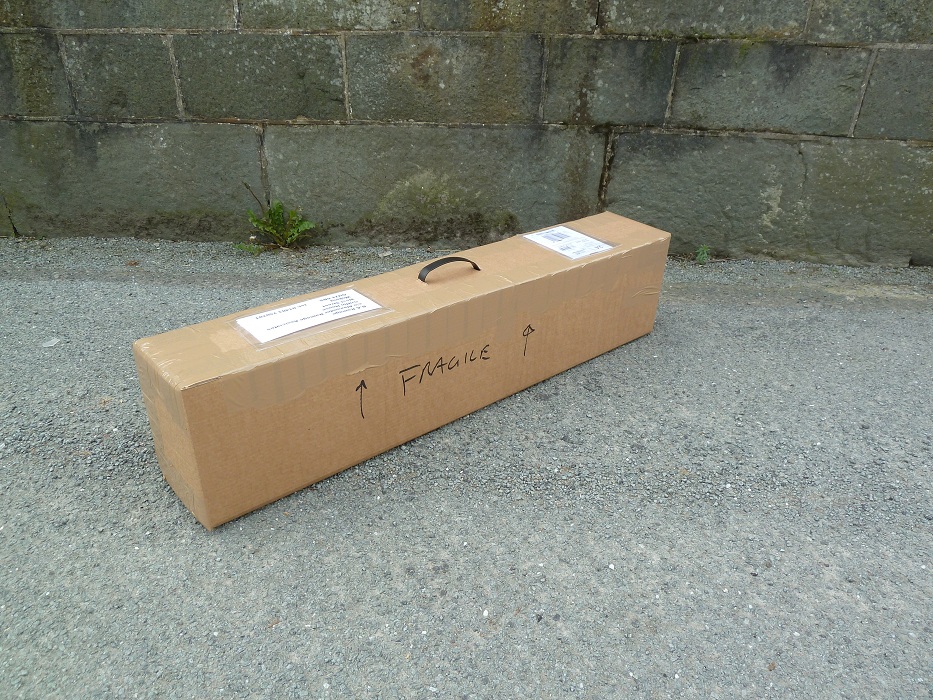
I do admire Robin's cunning psychological approach of providing a handle!

John Keane
@john-keane
10/14/12 04:34:41PM
181 posts


YAY!!!

Kristi Keller said:


Keith Young "Youngster" dulcimer arrived safely from Dusty Turtle. It appeared on my birthday with nary a boo boo via UPS. The voice is lovely and I am very happy. At last, a safe delivery!


Cheryl James
@cheryl-james
10/03/12 02:09:01AM
4 posts


Kristi did you pay via PayPal ? I'm sure that eBay will sort out the situation. Did you leave the dulcimer at the post office? The sender actually has to file the damage claim but it shouldn't affect you if you have pictures of the damage and proof if your purchase, etc. in my case I did also go back to eBay and filed a dispute and because I had paid via PayPal I was refunded rather quickly but I had turned the dulcimer over to the pt office as part of the claims process to assist the seller in is attempt to collect on his insurance claim. When it didn't go through he told me I could go back o the pot office and take the damaged instrument but I was so heart broken over it I jut didn't want to have anything further to do with it. Cheryl
john p
@john-p
09/20/12 06:58:37AM
173 posts


I can attest to the strength of Ken's Sonotube idea.

Don't let the word cardboard fool you, this is something that has to be cut with a saw rather than a knife.

May turn out a bit heavy if that affects shipping charges though.

john

Cheryl James
@cheryl-james
09/20/12 12:26:51AM
4 posts


I can feel your pain...I had purchased an early Edsel Martin dulcimer that the US Postal Service managed to maul through several protective layers. Though the seller had it fully insured, and the packaging was good/solid, the USPS workers declared that the damage was due to the seller's packaging of the instrument, even though one end was completely torn off and crushed. The seller refunded my money but in the end lost out on his end. After this very sad experience and others that friends have had it seems that UPS is a much safer ride for our precious instruments. I had a great talk with Aaron O'Rourke about this and an instrument I purchased from him that he had a guitar shop pack and send UPS. Triple layer protection in the packing, but even the box seemed perfect when it arrived a few days later. I think that they do take better care of their packages, but I also really like the idea of sending items in a tube...I would never have thought of this, thanks Ken!

Ken Hulme
@ken-hulme
09/12/12 08:17:13AM
2,157 posts


When I ship dulcimers, I use the ultra heavy (1/2" thick) cardboard tubes used as concrete molds for piers and posts, which you can find at Home Depot or Lowe's. It costs a couple bucks, but that's not a problem. I cut the tube a few inches over length and make end caps from corregated cardboard and tape one in place with balled up newspaper or whatever for end padding. Inside, I roll the dulcimer up in bubble wrap until it's a snug fit, side it into place, then tape on the other end cap. Because of the shape, any weight place on it or shoved into it tends to be deflected. Either that or the carrier stands it on end.

Robin Clark
@robin-clark
09/12/12 03:26:59AM
239 posts


I have one simple tip for shipping. It has served me well with my guitar business and so I do the same with the dulcimers I send out. Over the past5 years my shipping damage rate for guitars plus dulcimers is 0.25% (1:400) and I'm sure that is largely due to this little trick.

I put one of those heavy duty plastic box handles at the balance point of the box.

I find that the couriers naturally carry the box by the handle, load it the way up I want it loaded, and are less likely to drop or throw the box (it is easier to place the box than throw it once you have it by the handle). It is a bit of a psychological trick as well as a practical device - but it does seem to be working.

Robin

Kevin Messenger
@kevin-messenger
09/11/12 10:56:02PM
85 posts


I have shipped many instruments here and abroad with out a single problem. I build cradles within the box to support the instrument, and add lots of buffer padding all around. It has worked great so far. By the way , what has become of the damaged instruments. I build and might would be interested in repairing or maybe purchasing.

John C. Knopf
@john-c-knopf
11/04/12 09:55:32AM
448 posts

I believe I got a Mcspadden Sweet Song?


Instruments- discuss specific features, luthiers, instrument problems & questions

Gentlemen:

Looks 99.9% like a McSpadden Sweet Song assembled kit to me. I've built a couple of them, and they look JUST like this one. (Of course, the fit and finish on mine were much better! ).

RavenMadd Garcia
@ravenmadd-garcia
10/13/12 06:13:38PM
41 posts

I believe I got a Mcspadden Sweet Song?


Instruments- discuss specific features, luthiers, instrument problems & questions

yes mine measures the same.....had some dry finish section so I hit it with a touch of Watco walnut dark over the dry bits ...mine had missing strings ....did yours have the sticker inside of who put it together ,,,,,I've been busy slowly convert a old small guitar case for it .....

Don Johnson said:

Mine has, to me, a great sound. It is a lage instrument, 29 1/2 inch VSL, and a 2 1/2 inch deep box. I have posted in another forum here about the strings. It was missing the #1 melody, and I replaced with a .012, but the other two are smaller, and appear oxidized. But I like the sound. #2 has a ring to it, and I cannot imagine why. I have read here that the longer VSL can create a problem because of the longer frets, but I do not believe it will hurt Twinkle Twinkle Little Star a bit.

RavenMadd Garcia
@ravenmadd-garcia
10/13/12 11:48:37AM
41 posts

I believe I got a Mcspadden Sweet Song?


Instruments- discuss specific features, luthiers, instrument problems & questions

Don hows the sounds on yours?...mine is has a great mid range voice to her

Don Johnson said:

I, too, purchased a simular dulcimer from a Goodwill in Seattle. It has no name, and is a very large instrument.

folkfan
@folkfan
09/07/12 06:44:10PM
357 posts

I believe I got a Mcspadden Sweet Song?


Instruments- discuss specific features, luthiers, instrument problems & questions

Looks like someone tried to fix an intonation problem. I wouldn't think that would happen with a Sweet Song Kit.

Sam
@sam
09/07/12 06:35:38PM
169 posts

I believe I got a Mcspadden Sweet Song?


Instruments- discuss specific features, luthiers, instrument problems & questions

Awfully pretty grain in that wood. It does look like walnut. Congrats Rav.

RavenMadd Garcia
@ravenmadd-garcia
09/07/12 05:03:59PM
41 posts

I believe I got a Mcspadden Sweet Song?


Instruments- discuss specific features, luthiers, instrument problems & questions

how can you tell if its one?...I believe its made of walnut...its has a sticker inside that says alan and chet whisman....Dec 1997.....its sounds nice ....my digital camera is down...I got this off of goodwill.com some store in seattle ...


updated by @ravenmadd-garcia: 06/09/16 08:21:50PM
chuck queisser
@chuck-queisser
09/07/12 05:06:45PM
15 posts

just bought a dulcimer


General mountain dulcimer or music discussions

Workin on It,enjoy your videos.

R N Lackey said:

Nice! Will be looking forward to hearing it when you get a song or two "down."

Rob

  611